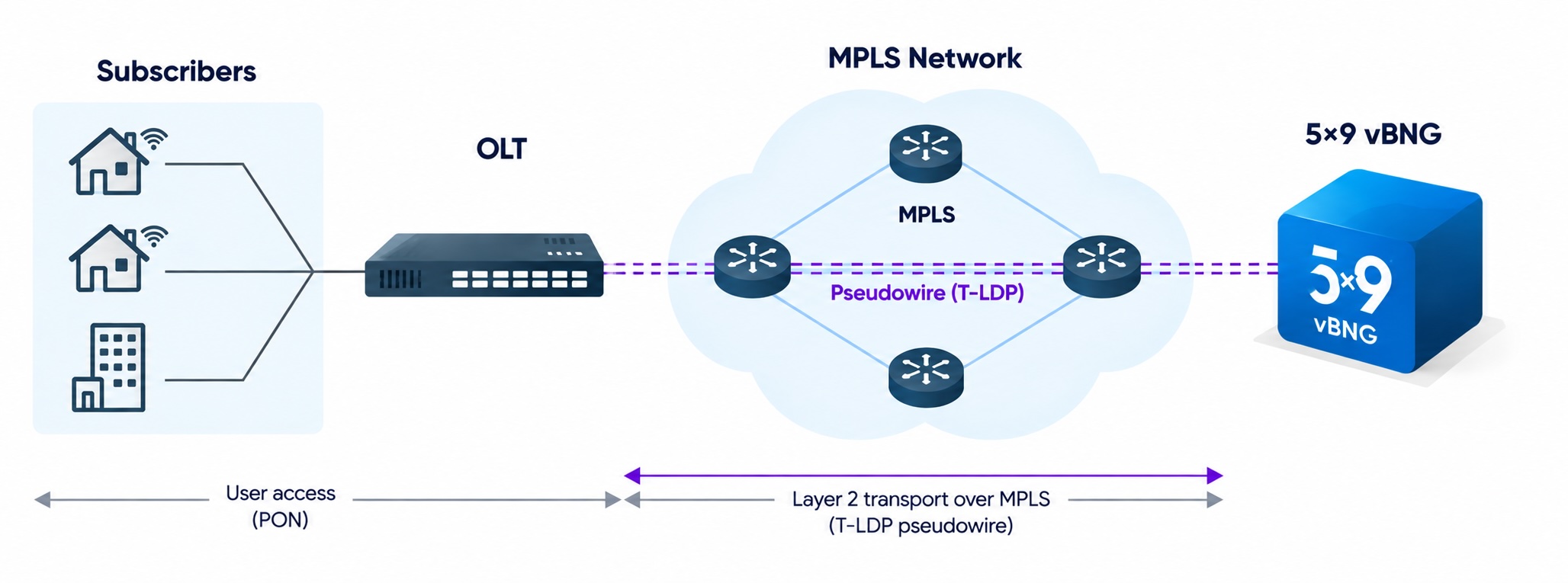
Extending Broadband Access with Pseudowires on 5×9 vBNG
In broadband networks, subscriber traffic from an OLT needs to reach the BNG as Layer 2 traffic, even when the access network and the BNG are separated by an MPLS transport network. 5×9 vBNG already supports EVPN for transporting Layer 2 subscriber traffic across MPLS networks. Now, we are adding another option – pseudowire support using Targeted LDP (T-LDP).
With T-LDP pseudowires, subscriber traffic from remote OLTs can be transported across an existing MPLS infrastructure and delivered to the 5×9 vBNG for subscriber session termination. This gives operators a choice between EVPN and T-LDP pseudowires, making it easier to integrate 5×9 vBNG into both modern and existing MPLS network architectures.
A Quick Look at 5×9 vBNG
5×9 vBNG is a software-based Broadband Network Gateway designed to run on standard x86 infrastructure. Instead of relying on proprietary networking hardware, it provides broadband edge functionality as a scalable software platform.
The architecture follows the Control and User Plane Separation (CUPS) principle and consists of three main components:
- vDB – virtual Dashboard, providing centralized configuration, management and monitoring
- vBC – virtual BNG Controller, responsible for control-plane functions, subscriber management and routing
- vBF – virtual BNG Forwarder, responsible for subscriber traffic forwarding
The vBNG terminates subscriber sessions, applies subscriber policies and QoS, and provides connectivity towards external networks.
Access networks, however, may be geographically distributed, while the vBNG infrastructure can be centralized in one or several data centers. Subscriber Layer 2 traffic therefore needs to be transported between remote OLTs and the vBNG. Until now, if you wanted to transport subscriber sessions over MPLS, 5×9 vBNG provided EVPN-based connectivity. With the addition of T-LDP pseudowires, operators now have another way to connect their access infrastructure to the vBNG over an MPLS network.
Connecting Remote OLTs
A pseudowire emulates a point-to-point Layer 2 connection across a packet-switched network. From the perspective of the endpoints, it behaves much like an Ethernet connection. Underneath, however, Layer 2 frames are encapsulated and transported across the MPLS network. In the 5×9 vBNG use case, the pseudowire has a very specific purpose, transporting subscriber Layer 2 traffic between an OLT and the 5×9 vBNG. The MPLS network provides the transport, while the pseudowire provides the Layer 2 connectivity required between the access network and the BNG.
Consider an operator with an OLT deployed at a remote location. Subscriber traffic arrives at the OLT, while the 5×9 vBNG responsible for terminating those subscriber sessions is located elsewhere in the network. Between them, the operator already has an MPLS transport network. The required connectivity looks like this:
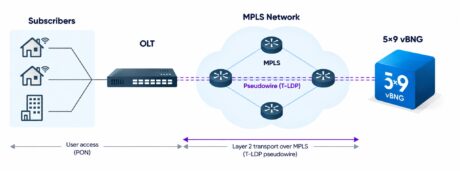
The OLT and the vBNG need Layer 2 connectivity so that subscriber traffic can reach the vBNG in the same way it would over a traditional Ethernet aggregation network. 5×9 vBNG can provide this connectivity using EVPN or a pseudowire. The new pseudowire option is particularly useful for integration with MPLS networks where pseudowires are already part of the operator’s existing architecture.
The pseudowire is signaled using Targeted LDP (T-LDP). Unlike regular LDP neighbor discovery, which is typically performed between directly connected MPLS routers, T-LDP allows an LDP session to be established between pseudowire endpoints that do not need to be directly connected. Through this session, the endpoints exchange the MPLS label information required to establish the pseudowire. Subscriber traffic can then be carried across the MPLS infrastructure using the appropriate MPLS labels. At the vBNG side, the MPLS encapsulation is removed and the original Layer 2 subscriber traffic is delivered to the vBF. From that point onward, subscriber processing works in the same way as with a locally connected Layer 2 access network.
EVPN remains available as a modern and scalable approach for providing Layer 2 connectivity across MPLS infrastructure. However, not every operator network uses EVPN for its access transport. Many existing MPLS deployments already rely on pseudowires for point-to-point Layer 2 services. By supporting both approaches, 5×9 vBNG can integrate with different transport architectures – the goal is not to replace EVPN, but to give operators more flexibility when integrating the vBNG into their existing network.
More Options for the Broadband Edge
Virtualizing the BNG makes it possible to place subscriber termination where it makes the most operational sense. Subscriber traffic, however, still needs an efficient way to reach that location. 5×9 vBNG already addressed this with EVPN support. With the addition of pseudowires, operators now have another option for transporting Layer 2 subscriber traffic from remote OLTs across their MPLS infrastructure.
Whether the transport architecture is based on EVPN or traditional pseudowires, the objective remains the same, bringing subscriber traffic from the access network to the 5×9 vBNG, where the subscriber sessions are terminated and managed. This additional flexibility makes it easier to introduce 5×9 vBNG into both new network designs and existing MPLS deployments without requiring operators to redesign their transport network around the BNG.